

Sprinter 213CDi Brake Fluid Change – Step-by-Step Guide
Introduction
I had neglected this job for quite a while. When I bought the Sprinter, I was told that all maintenance had already been done. But don’t they always say that?
If we haven’t actually seen a service report, it’s better not to trust those claims too much. The safest approach is to redo all maintenance ourselves from scratch using products we know and trust.
So yes, after thousands of kilometers, I finally started this job. My brake pads had been replaced a long time ago and they still look perfectly fine.


Draining the Old Brake Fluid Without Introducing Air
What I wanted to do was completely drain the old brake fluid from the system without letting air enter the lines.
First, I removed as much of the old fluid as I could from the brake fluid reservoir and filled it back up with fresh brake fluid.
Then I removed the wheel that is farthest from the brake master cylinder (rear right) so I could reach the brake caliper more easily.
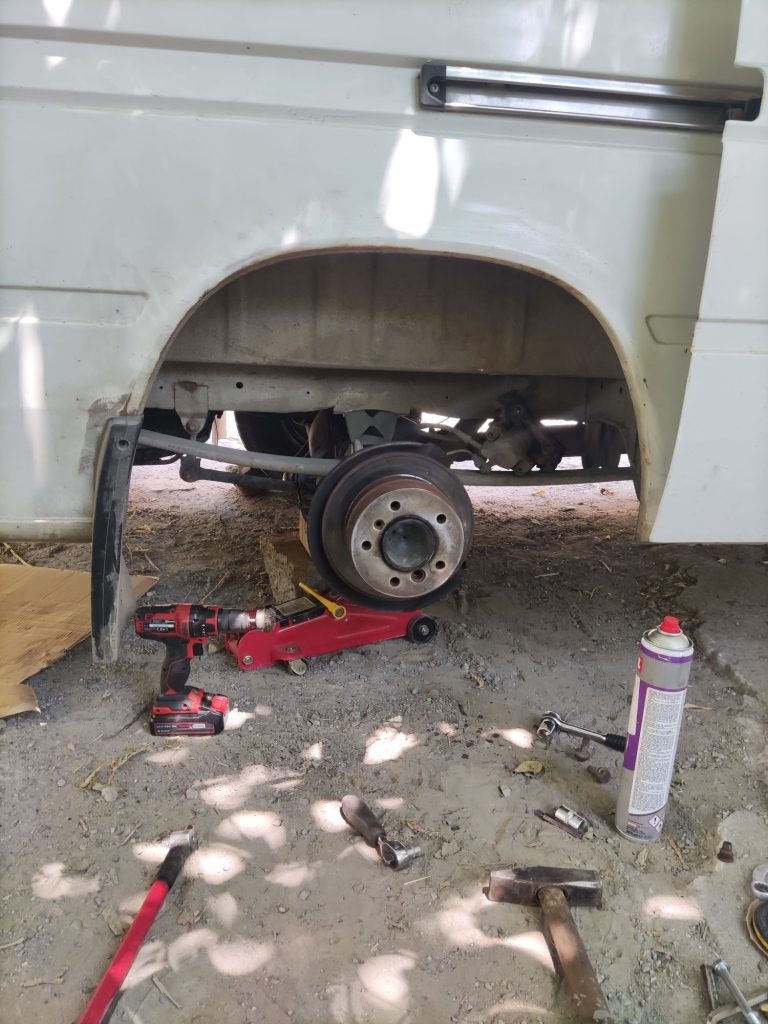

Bleeding the Brake System
When you pump the brake pedal and keep it pressed, loosening the caliper bleed valve causes the old brake fluid to shoot out. After that, you tighten the valve again.
Then you release the brake pedal, pump it again, and hold it down while repeating the same process.
During this procedure, it’s important to constantly monitor the fluid level in the reservoir. As the level drops, immediately refill it with fresh brake fluid.
The difference between old and new brake fluid is very easy to see.


Moving to the Other Wheels
Once you see fresh brake fluid flowing from the bleed valve, that wheel is finished and you can move on to the next one.
The second wheel farthest from the master cylinder is the rear left wheel. Again, I removed the wheel to make access easier.
If the vehicle were on a lift, the bleeding could easily be done without removing the wheels. But I don’t have a lift, and I actually enjoy cleaning rusty areas when I remove the wheels.
Besides, removing a wheel takes me less than five minutes.
Using a Hose for Clean Fluid Collection
While bleeding the brakes, I attach a transparent hose to the bleed valve and place the other end inside a plastic bottle.
This way the brake fluid doesn’t spill everywhere and is safely collected in a container.
By starting with the wheel farthest from the master cylinder and working toward the closest one, you effectively renew the entire brake system fluid.
Tools and Materials Needed
- 11 mm socket (to loosen stuck bleed valves)
- 11 mm box wrench
- Transparent hose
- Plastic bottle for collecting used brake fluid
- Rust penetrant for stuck bleed valves – XCP ONE
- High-quality brake fluid (2 liters recommended)
I actually considered replacing the brake hoses as well while doing this job. That would have been a healthier long-term solution.
However, I had already done many tasks in a short time, so even changing the brake fluid alone felt like a great improvement.
Hopefully I’ll replace the brake hoses another time, because the condition of the hoses is extremely important — maybe even the most important part of the braking system.
Brake Fluid Choice
For this job I chose MOTUL DOT 3 & DOT 4 brake fluid.
The wet boiling point of DOT 3 & DOT 4 fluid is 160°C
(DOT 3: 140°C – DOT 4: 155°C)
This means it performs better than both standard DOT 3 and DOT 4 fluids. It is also 100% synthetic.
The dry boiling point is 245°C
(DOT 3: 205°C – DOT 4: 230°C)
If you plan to use this brake fluid, keep the following in mind:
It can be mixed with non-silicone-based DOT 3, DOT 4, and DOT 5.1 fluids.
However, do not mix it with silicone-based brake fluids (DOT 5) or mineral-based fluids such as LHM.
How Often Should Brake Fluid Be Changed?
Inspection interval: 45,000 km / 900 hours
Replacement interval: Every 24 months
To remove most of the old fluid from the system, about 1.5 liters of brake fluid is usually sufficient.
Brake fluid is hygroscopic, which means it absorbs moisture from the atmosphere. That’s why it’s recommended to replace it every two years.
Moisture absorbed by the brake fluid can cause corrosion in cylinders and calipers.
Regularly replacing the brake fluid is probably one of the most overlooked maintenance tasks in most vehicles.
By simply replacing this fluid, you can significantly extend the life of your hydraulic braking system.